
X-ray Booking

Costings (Internal)
When booking time you will be asked to put down a grant code. This is so that appropriate SRF funding can be recouped and the facility running costs can be accurately accounted for. Funding is only taken if there is a portion of a grant ringfenced for SRF usage, it will not affect consumables or other research budget items. If there is no suitable grant then please write 'no grant'. For example, if:
-
The user puts down a grant code and there is SRF allocated money on that grant available : Finance will take the funds from the SRF allocation.
-
The user puts down a grant code but there isn't SRF allocated money on that grant available: Finance will check the grant for SRF allocation, and if there isn't any, they won't take any funds. Any unspent consumables budget might be recouped when the grant ends.
-
The user puts down no grant : Finance won't check for funds.
Please check with your supervisor/the grant holder what to enter. A lack of SRF funding will never affect access or usage of this facility.
Instructions
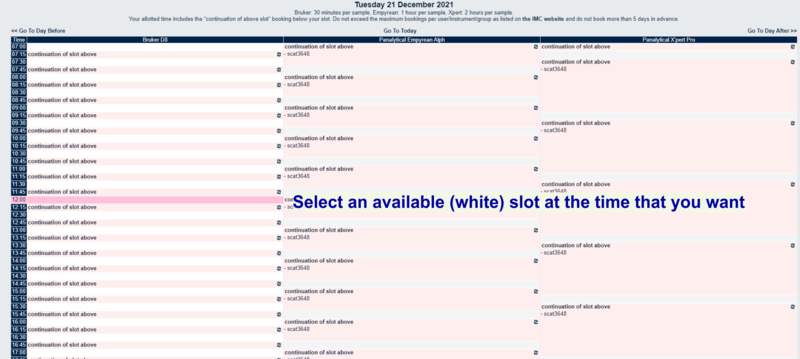
1.
|
2.
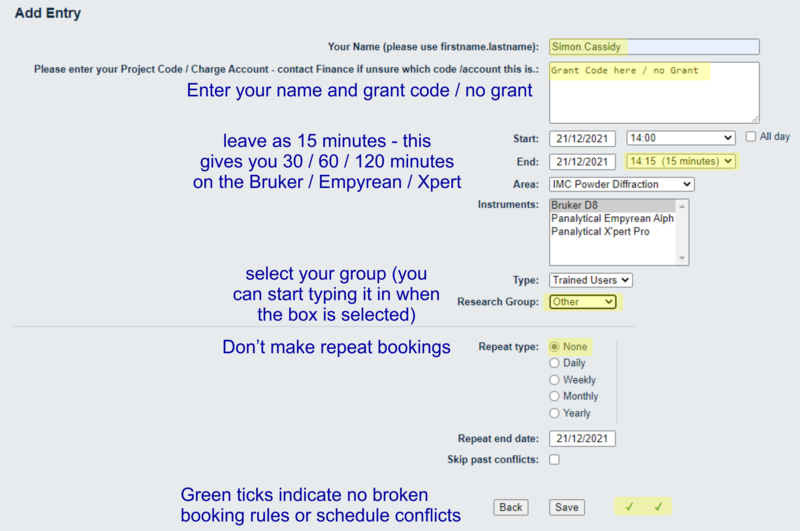
|
Rigaku Smartlab Reactor-X stage
The Reactor-X stage is capable of rapidly heating a powder sample between room temperature and 950 degrees Celsius on the copper sourced Rigaku Smartlab diffractometer. The sample can be exposed to a variety of environments whilst data is collected. Further information and an application form can be found below:

Empyrean Mo with PheniX
The molybdenum sourced diffractometer can collect diffraction patterns from 15 to 300 K. A typical collection time per temperature is 2 hours, which means a full variable temperature sweep can take several days. The total time required is not a problem - the instrument can measure continuously in a programmed way, so do not be put off from requesting a set of measurements by the amount of time that it takes. What is very important, is that the data collected are meaningful.
To that end, if you wish to measure a sample(s) using the PheniX, please fill in the application form below and submit it to the facility supervisor along with a diffraction pattern of the proposed sample(s) in .xy format:

